
The US remained India's largest trading partner for the fourth consecutive year in 2024-25 with bilateral trade valued at $131.84 billion, while the country's trade deficit with China widened to $99.2 billion during the same period, government data showed. In the last fiscal, India's exports to China contracted 14.5 per cent to $14.25 billion as against $16.66 billion in 2023-24. The imports, however, rose by 11.52 per cent in 2024-25 to $113.45 billion against $101.73 billion in 2023-24.

The official said there are both challenges and opportunities for India as many of its competitor countries in exports, such as China Vietnam, Bangladesh, Cambodia and Thailand, face higher duties.
After remaining in the positive zone for three months, India's exports contracted 1.2 per cent to $33.98 billion in July, while the trade deficit widened to $23.5 billion.

These duties will come into force from April 9.

However, copious oil supplies amid growing global output and slowing Chinese oil consumption will put India in a better bargaining position with Gulf suppliers.

The Indian industry is paranoid about the USA's plan to impose reciprocal tariffs and wants early conclusion of a bilateral trade agreement, sources said on Wednesday. They said that the talks for the proposed bilateral trade agreement are going well.

Exports had recovered in November to grow at 0.59 per cent from a 12 per cent contraction in October.

US strikes on Iran's three main nuclear facilities have once again raised concerns that Tehran might shut down the Strait of Hormuz - one of the world's most critical chokepoints, through which a fifth of global oil and gas supply flows.

The Trump trade shock is a chance to push long-overdue reforms, rather than tinker with tariffs to appease the US, suggests M Govinda Rao.
An Indian official team is likely to visit Washington next week to iron out differences on certain issues before formally launching negotiations for the proposed India-US bilateral trade agreement (BTA), an official said. The visit, which comes within weeks of a high-level US team visiting India, indicates that the talks for the BTA are gaining momentum.

Amid the ongoing global tariff war, Reserve Bank Governor Sanjay Malhotra on Wednesday said he is more worried about its impact on growth than inflation. Speaking to the media after presentation of the first bi-monthly monetary policy for the current financial year, Malhotra said, RBI has reduced the growth forecast for 2025-26 by 20 basis points to 6.5 per cent.

Oil share declines to 9.35 per cent in April-September from 17.23 per cent in the same period of last year.
India and the US have decided to hold sector-specific talks in the coming weeks to finalise the structure of the proposed bilateral trade agreement (BTA), the government said on Saturday. The engagement between the two countries came in the backdrop of the USA's threat to impose reciprocal tariffs on its key trading partners, including India, on April 2.

Here is a list of Q & As to explain these issues and implications of the US move.
India's merchandise exports in April 2024 marginally rose to $34.99 billion from $34.62 billion in the year-ago month, according to government data released on Wednesday. Imports too increased to $54.09 billion from $49.06 billion in April 2023.

'We need to be very vigilant as we are passing through some fraught times.'
India recorded the highest monthly exports during the fiscal in February, registering an 11.9 per cent growth to $41.4 billion, mainly driven by increased shipments of engineering goods, electronic items and pharma products. The trade deficit during February worked out to $18.7 billion, up from $16.57 billion in the year-ago month, as gold imports surged significantly. Merchandise imports were valued at $60.11 billion, up 12.16 per cent compared to $53.58 per cent in February 2023.
India and the visiting US officials have decided to hold a wrap-up session on Saturday morning to conclude the three-day talks on the proposed bilateral trade agreement, government sources said. They said the discussions are at a "very" early stage.
Senior officials of India and the US will begin three-day talks on the proposed bilateral trade agreement in New Delhi on Wednesday amid threats of reciprocal tariffs from the Trump-administration, an official said. To formally start the negotiations on the pact, Assistant US Trade Representative for South and Central Asia Brendan Lynch, along with a team of officials, is in New Delhi.

The US has sanctioned an Indian national based in the United Arab Emirates and two India-based entities for operating as part of Iran's shadow fleet and involved in shipping Iranian oil. The US Department of the Treasury said Jugwinder Singh Brar, who owns multiple shipping companies, operates as part of Iran's shadow fleet, which the US said is used to evade sanctions and transport Iranian oil. Brar also owns or controls India-based shipping company Global Tankers Private Limited and petrochemical sales company B and P Solutions Private Limited. The sanctions come as part of a US campaign of maximum pressure on Iran and target the country's petroleum and petrochemical sectors.

Markets crashed the world over, share prices slumped, prices of airline tickets went up. All because of global crude oil prices, which touched a record $41 per barrel and output capacity of OPEC. Take the rediff biz quiz and know all about OPEC
India's exports declined by 2.83 per cent to $33.90 billion in November this year compared to $34.89 billion a year ago, government data released on Friday showed. Imports also declined to $54.48 billion in the month under consideration, as against $56.95 billion recorded in November 2022.

Of Trump's reciprocal tariffs and trade deals
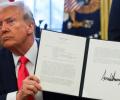
The sweeping tariffs proposed across sectors by US President Donald Trump are scheduled to be imposed starting April 2, with most analysts worried about their impact on companies, and in turn the financial markets. Recently, the US administration signaled that it will impose sectoral tariffs on energy, pharmaceuticals, semiconductors, agriculture, copper, and lumber.

The country's exports edged up 1 per cent to $38.45 billion in December 2023 while the trade deficit narrowed to a three-month low of $19.8 billion, official data released on Monday showed. Imports declined by 4.85 per cent to $58.25 billion in December last year due to a dip in crude oil shipments. The previous low in trade deficit - the difference between imports and exports - was recorded in September at $19.37 billion.

Soft oil prices are expected to persist in 2015 and will be accompanied by significant real income shifts from oil-exporting to oil-importing countries.

India and the United States will finalize the contours, schedule of negotiations, and terms of reference for a proposed bilateral trade agreement (BTA) during a three-day meeting beginning Tuesday. The agreement is expected to be finalized in two tranches, with the first phase focusing on goods trade. The US team, led by Assistant US Trade Representative for South and Central Asia Brendan Lynch, will be in India from March 25-29 to discuss the agreement. Both countries are aiming to conclude the first phase of the agreement by fall 2025.
The assurance came after a meeting of the Saudi Arabia's Supreme Council for Petroleum and Mineral Affairs, which was chaired by King Abdullah. The meeting, which reviewed world oil market developments, referred to the resolution taken by the last OPEC summit in Riyadh in which leaders said they would manage petroleum resources to ensure sustained development. The summit expressed its satisfaction over the progress of work at new investment projects.

The country's exports dipped 8.74 per cent to $23.52 billion in November on account of contraction in shipments of key sectors like petroleum, engineering, chemicals and gems and jewellery, official data showed on Tuesday. Trade deficit during the month narrowed to $9.87 billion as imports too declined by 13.32 per cent to $33.39 billion.
A healthy growth in India's services segments has helped the country's total exports and imports of goods and services to cross the $800 billion mark during the first half of 2023, despite a slowdown in global demand, think tank GTRI said in a report on Monday. According to the analysis of the Global Trade Research Initiative (GTRI), exports of goods and services rose by 1.5 per cent to $385.4 billion during January-June this year, as against $379.5 billion in January-June 2022. Imports, however, dipped by 5.9 per cent to $415.5 billion during the six months of this year, as against $441.7 billion in January-June 2022.

Exports declined for the fourth-consecutive month by 10.3 per cent year-on-year to $34.98 billion in May, while the trade deficit widened to a five-month high of $22.12 billion. According to the data released by the commerce ministry on Thursday, key export sectors recording negative growth include petroleum products, gems and jewellery, engineering goods, ready-made garments of all textiles and chemicals. Imports also declined 6.6 per cent, six-month in a row, to $57.1 billion against $61.13 billion in the same month last year, the data showed.

Indian imports of Russian crude oil may stabilise or even decline in 2024 from record 2023 levels amid shrinking discounts, lower output, and a rebound in West Asian supplies, according to the ship-tracking data and industry executives. This may impact the billions of dollars in annual savings that India made last year. Imports of Russian oil jumped by a record 140 per cent in calendar 2023 to 1.79 million barrels a day (b/d) from 740,400 b/d in 2022, when Russia marched into Ukraine in February, and from just 102,000 b/d in 2021, according to the data from Paris-based market intelligence agency Kpler.

After a spike in crude oil and gas prices in October following the Hamas terror attack, prices eased down 9 per cent month-on-month in November. The Organization of the Petroleum Exporting Countries (Opec) and Opec+ agreed to a further voluntary production cut in January-March 2024 to try and support global crude prices. The best guess here is that crude prices (currently at $75/barrel, or bbl) will not likely cross significantly above $80, and gas prices are also likely to remain subdued unless there's a further escalation in the Israel-Hamas conflict.

While OPEC has been unable to agree on an output freeze in an effort to support prices, Iraq was the latest Middle East producer to raise its exports quota

'As the markets are expected to remain jittery in the near term, we advise investors to use this opportunity to enter quality largecaps from a long-term perspective.'

The Budget has given signals that India is sensitive to the US needs and willing to walk the extra mile, but if need be, we should respond in equal measure as a sovereign nation, notes Ajay Srivastava.
India has asked oil cartel Organization of the Petroleum Exporting Countries to raise crude oil production to stem the relentless rise in international oil prices that have threatened to derail import dependent economies such as India.
The government on Monday scrapped 30-month old windfall profit tax on domestically-produced crude oil and on export of jet fuel (ATF), diesel and petrol following a decline in international oil prices. Minister of State for Finance Pankaj Chaudhary tabled a notification in Rajya Sabha scrapping the levy on crude oil produced by firms like state-owned Oil and Natural Gas Corporation (ONGC) and exports of fuels done by companies like Reliance Industries Ltd.

The government has cut the windfall profit tax on crude oil produced in the country while the levy on exports of diesel and ATF has been hiked, an official notification said. The tax, levied in the form of special additional excise duty or SAED, on domestically produced crude oil was reduced to Rs 6,700 per tonne from Rs 7,100 a tonne. SAED on the export of diesel was increased to Rs 6 per litre from Rs 5.50 a litre and on jet fuel or ATF to Rs 4 per litre from Rs 2, the notification said.
 © 2026 Rediff.com - Advertise with us - Disclaimer - Privacy Policy - Sitemap - Feedback - About us - Terms of use - Grievances